
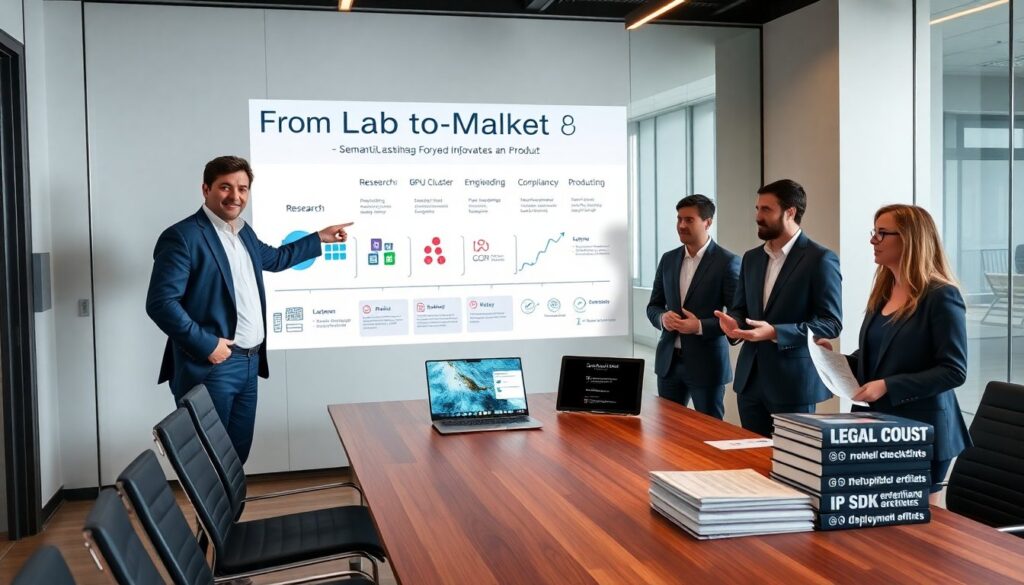
From lab to market semanticlast describes how researchers convert prototypes into products. SemanticLast moves models, data, and code from experiments into deployed services. It aligns engineering, compliance, and business teams. This guide explains key steps. It shows how SemanticLast validates models, scales infrastructure, protects intellectual property, and launches with customers.
Key Takeaways
- SemanticLast enables seamless transition from lab prototypes to market-ready semantic search products by integrating research artifacts into scalable, reproducible modules.
- Validating models through proofs of concept and benchmarking with precision and latency metrics ensures production readiness and stakeholder confidence.
- Pilot studies with early adopters using A/B testing and feature flags help refine models and user experience before wider market launch.
- Engineering for production involves containerization, autoscaling, CI/CD, and automated retraining to achieve scalable, reliable, and low-latency SemanticLast deployments.
- Compliance and IP management, including data governance, audits, and licensing, reduce legal risks and protect proprietary research during commercialization.
- A strong go-to-market strategy with clear pricing, developer support, and aligned sales efforts drives customer adoption and smooth integration of SemanticLast solutions.
What SemanticLast Is And The Core Technology Behind It
SemanticLast combines semantic search, vector databases, and fine-tuned models. It packages research artifacts into reproducible modules. The platform stores embeddings, metadata, and model checkpoints. It offers APIs for retrieval, ranking, and generation. It uses dense vector search and sparse signals together. It runs model training on GPU clusters and inference on optimized CPU/GPU nodes. It supports multiple architectures and formats. It logs data and predictions for audit and retraining. Teams use SemanticLast to move from lab to market semanticlast work with clear interfaces and version control.
Proof Of Concept: Validating Models And Datasets
Teams use proofs of concept to test feasibility and value. A POC shows model accuracy, latency, and integration effort. It uses representative datasets and simple pipelines. It measures both offline metrics and real user signals. It captures failure cases for further training. Project owners report results to stakeholders and plan next steps.
Benchmarks And Performance Metrics
Engineers run benchmarks to compare model variants. They measure precision, recall, F1, latency, and throughput. They report embedding similarity and MRR for search tasks. They track cost per query and GPU hours per training run. They set target KPIs for production readiness. They repeat benchmarks on new data and on scaled hardware to verify consistency.
Pilot Studies And Beta Programs With Early Adopters
Product teams run pilots with small customer groups. They deploy features behind feature flags and collect usage logs. They ask early adopters for direct feedback on relevance and speed. They A/B test different ranking approaches and UI flows. They iterate on models and data pipelines weekly. They document results and prepare SLA commitments before wider release. SemanticLast helps teams run pilots that move from lab to market semanticlast projects into real customer use.
Engineering For Production: Scalability, Infrastructure, And MLOps
Engineering teams design systems for scale and reliability. They containerize models and serve them with autoscaling clusters. They use orchestration tools to manage deployments and rollbacks. They separate training and inference environments to reduce risk. They carry out CI/CD for models, tests, and data schema changes.
They instrument pipelines to collect metrics and traces. They automate retraining when data drift exceeds thresholds. They cache embeddings and use sharded vector indexes to lower latency. They provision multi-region deployments for fault tolerance. They encrypt data in transit and at rest. SemanticLast provides native tooling to support each step and to reduce time to move from lab to market semanticlast initiatives.
Compliance, IP, And Data Governance For Commercial Deployment
Legal teams define data use and licensing rules early. They classify datasets for sensitivity and retention. They establish consent records and data lineage for audit. They apply access controls and role-based policies. They register patents and record model provenance to protect intellectual property.
They prepare compliance reports for regulators and enterprise customers. They redact personal data and apply differential privacy techniques where required. They run audits of third-party datasets and model components. They create export controls and licensing terms for commercial use. These steps help teams take research and move from lab to market semanticlast products with less legal risk.
Go‑To‑Market Strategy: Pricing, Integration, And Driving Customer Adoption
Product teams define pricing that reflects value and cost. They choose between usage-based, subscription, and tiered models. They bundle API access, support, and custom training services. They create clear onboarding and SDKs for integration.
They build reference integrations for common platforms and publish developer guides. They run workshops and technical pilots to reduce integration friction. They align sales and engineering teams on SLAs and escalation paths. They collect case studies and ROI data from pilots to support sales. Marketing focuses on product benefits, not technical detail.
Sales teams target early adopter verticals and scale outward. They monitor churn and expand feature sets based on customer needs. SemanticLast firms price and package offerings so research can move from lab to market semanticlast stages efficiently.