
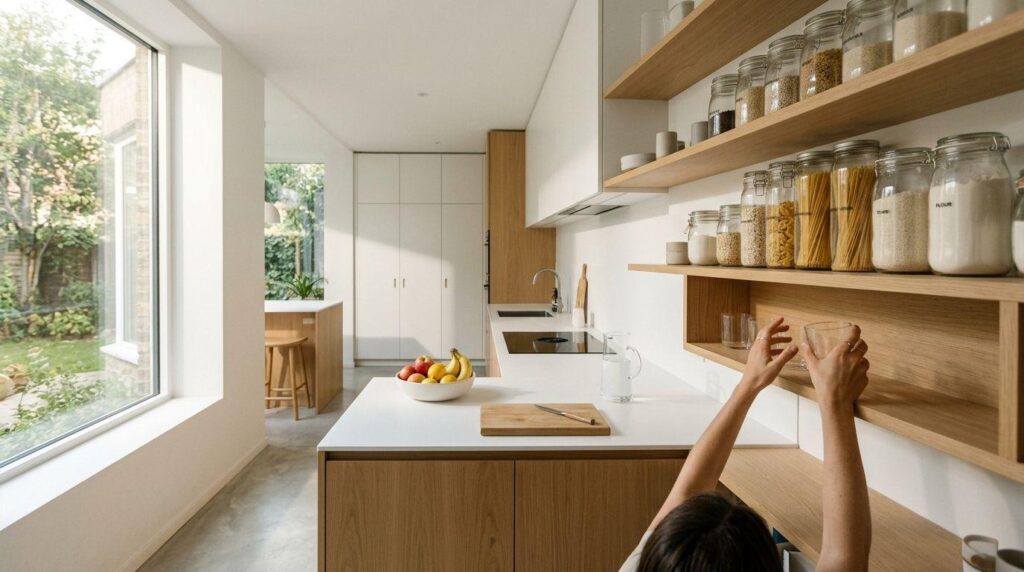
Most people try to build better routines by relying on discipline alone, yet the environment around them quietly decides how easy or hard that routine turns out to be. Low-friction kitchen design is one of the clearest places to see this principle at work, because a kitchen is a room visited many times a day, often when energy and patience are already running low. Small obstacles in that space, like a cluttered counter or a hard-to-reach pan, add up into resistance that no amount of motivation fully overcomes.
This article looks at why physical surroundings shape behavior more reliably than willpower, where everyday friction tends to hide, and which structural changes actually compound into lasting routines. The kitchen serves as the running example throughout, since food preparation is a habit almost everyone repeats daily, but the underlying logic applies to any room where consistency matters.
TL;DR — Key Takeaways
Why Environment Design Shapes Daily Habits
Behavior tends to follow the path of least resistance, and the physical layout of a space determines exactly how much resistance exists before a person even starts thinking about a task. When a cutting board sits directly next to the stove, chopping vegetables becomes the default next step. When it is buried in a drawer across the room, that same action requires an extra decision, and extra decisions are where good intentions quietly stall.
This is the mechanism behind cue-based habit formation: a visible, accessible object acts as a trigger, prompting action almost automatically, while a hidden or inconvenient object requires a deliberate choice every single time. Motivation is finite and fluctuates with mood, sleep, and stress, but a well-placed cue works the same way on a good day and a bad one. That reliability is precisely why relying on willpower alone tends to produce inconsistent results, while shaping the surrounding space produces steadier ones.
This does not mean discipline is irrelevant. It means discipline is easier to sustain when the environment is not constantly working against it. A kitchen where healthy staples are visible and awkward tools are stored out of the way removes a layer of resistance before any conscious effort is even required. Over weeks and months, that reduced resistance is what separates a habit that sticks from one that quietly fades after the first burst of enthusiasm wears off.
The Hidden Friction Points in Everyday Routines
Daily routines rarely fail because of one dramatic obstacle; they erode through many tiny frictions that go unnoticed individually but add up across a full day. Deciding what to wear, what to eat, where to put something down, and how to fit a task into a busy schedule all draw on the same limited pool of mental energy. By the time evening arrives, that pool is often depleted, which is exactly when a poorly organized kitchen becomes most likely to derail a planned routine.
Clutter compounds this problem in a specific way: disorganized spaces force the brain to process visual noise before it can even identify the object it needs. A countertop covered in unrelated items means a few extra seconds of scanning every time, and those seconds repeat dozens of times a day. Common friction points tend to cluster around a few recurring patterns:
None of these frictions feel significant on their own, which is exactly what makes them dangerous to a routine. They do not trigger a conscious decision to give up; they simply make the desired action slightly less convenient than an easier alternative, and over time the easier alternative wins by default.
Small Structural Changes That Compound Over Time
Reducing friction does not require a full renovation; it requires identifying which small adjustments remove repeated decisions rather than just tidying appearance. Storing frequently used items at eye level is one of the most effective changes available, because it eliminates the bending, searching, and shifting that otherwise precede a simple task. A spice rack at eye height, for instance, turns seasoning a meal into a glance-and-grab action instead of a small excavation project.
The same logic extends to how a kitchen’s storage is organized as a whole. Grouping items by function rather than by where they happen to fit, keeping a clear zone for daily-use tools, and separating rarely used equipment from everyday essentials all reduce the number of micro-decisions required to complete a routine task. Kitchens with well-organized storage, including appliances such as a built in Fridge Freezer, reduce the number of small daily decisions around food preparation simply because ingredients are easier to see, reach, and put back in a consistent place.
What makes these changes compound rather than fade is that they are structural, not motivational. A person does not need to remember to be organized each morning if the storage itself already enforces the pattern. This is the same principle behind arranging a home office so that work materials are the only thing visible on the desk, or laying out gym clothes the night before: the environment carries part of the habit’s weight so the person does not have to summon fresh willpower for it every single day.
Turning Intentional Design into Consistency
A one-time reorganization solves today’s friction, but living spaces drift back toward disorder unless the design is checked and adjusted periodically. New items enter a kitchen, old habits shift, and storage that made sense a few months ago can quietly stop matching how the space is actually used. Left unchecked, this drift recreates the exact friction points the original changes were meant to remove.
A practical approach is to treat the kitchen, or any habit-supporting space, the same way a routine itself is treated: something to review rather than something to set once and forget. Walking through the space and noticing where hesitation or extra steps have crept back in is often enough to catch small problems before they undo months of consistency. This review does not need to be elaborate; noticing which drawer has become a catch-all again, or which shelf now requires reaching past unrelated items, is usually sufficient to identify what needs resetting.
Consistency, in this sense, is less about willpower sustained indefinitely and more about maintaining an environment that keeps making the desired behavior the easiest option. Each adjustment, however small, is a way of reinforcing the same underlying idea: habits last longest when the space around them keeps quietly pointing in the right direction, rather than requiring constant conscious correction.
Frequently Asked Questions (FAQ)
Where should someone start when trying to reduce friction at home?
Starting with the single most frequently repeated task, such as morning food preparation, tends to produce the clearest results, since even small changes there are noticed dozens of times a week.
Does decluttering alone fix decision fatigue?
Decluttering helps, but organizing by actual use pattern matters more than simply removing items, since a tidy space that still requires searching does not reduce the underlying friction.
How often should a home routine be reviewed for new friction points?
There is no fixed interval, but a periodic check whenever a routine starts feeling harder than it used to is usually enough to catch drift before it undoes earlier progress.